AI isn't taking jobs. It's taking tasks.
Almost every conversation about AI and work starts in the wrong place. We ask whether a job will survive, when the unit that actually changes is the task. A job is a bundle of twenty or thirty different activities. AI does not arrive and remove the bundle. It arrives and quietly absorbs four of them, then seven, then twelve — until the bundle that's left no longer justifies the role as it was written.
This is why headlines about "jobs at risk from AI" feel both alarming and useless. They operate at a level of abstraction where nothing actionable lives. The useful question is narrower: which parts of what I do every week are the parts machines are getting good at?
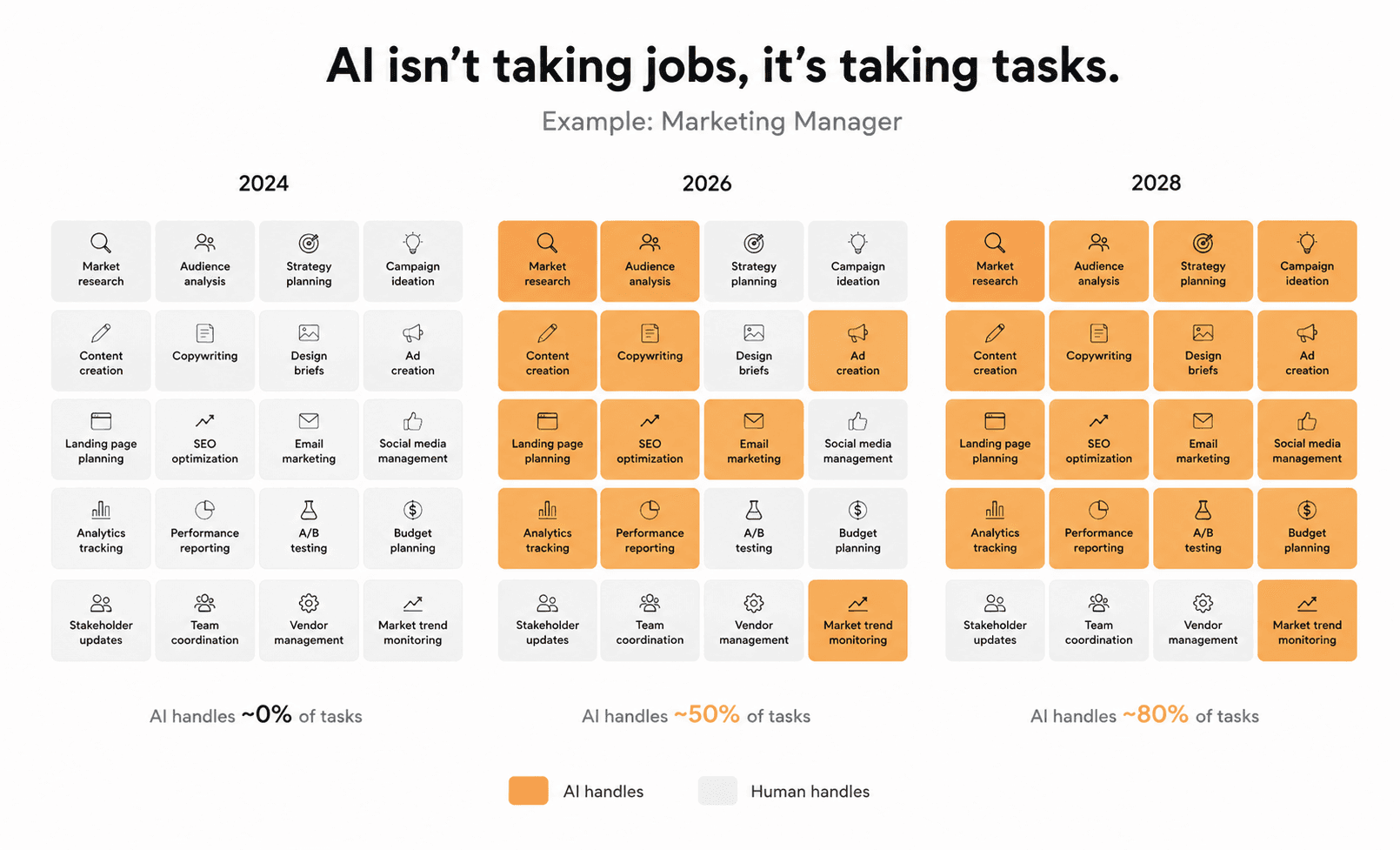
The same job title can carry very different risk
Two people share a title. One spends most of the week producing routine reports, cleaning spreadsheets, and writing first drafts of standard documents. The other spends it interpreting ambiguous results, negotiating with stakeholders, and deciding what the organisation should do next. Same title on LinkedIn. Substantially different exposure.
- A marketing associate who mostly writes variations of campaign copy sits in a very different position from one who owns positioning and channel strategy.
- A financial analyst building the same monthly model is more exposed than one who is asked which assumptions are wrong and why.
- A support specialist handling tier-one tickets faces a different curve from one who handles escalations where the policy doesn't cleanly apply.
- A developer writing well-specified CRUD endpoints is in a different place from one designing how systems fit together and fail.
Notice the pattern. Exposure tracks how routine, well-documented, and self-contained the work is — not how technical it is, not how senior it sounds, and not what industry it's in. Some highly technical work is quite exposed. Some non-technical work is barely touched.
Why awareness matters more than prediction
You cannot control when AI capability crosses a threshold in your field. You can control whether you notice which parts of your work are approaching that line. People who know their exposure make different choices: they take the project that builds judgment over the one that builds throughput, they learn the tool that extends their thinking rather than the one that automates their typing, they have a clearer answer when a manager asks what they'd do with more capacity.
The goal isn't to predict the future. It's to stop being surprised by the present.
Why "just learn AI" isn't enough
The standard advice is to learn AI. It's not wrong, it's just empty — the equivalent of telling someone worried about their health to "get fit." Fit for what? Starting from where? Doing which thing on Tuesday morning?
There is too much content, not too little
The bottleneck stopped being access to information years ago. There are more free courses, threads, newsletters, and tutorials on AI than any person could work through in a decade. The shortage is not material. The shortage is a reason to pick one thing over another.
Learning random tools doesn't compound
It is entirely possible to spend six months collecting tools — a prompt library here, an automation platform there, a certificate somewhere else — and end up with a longer list of things you've touched but no stronger position than when you started. Skills compound when they stack in a direction. They don't compound when they're a scatter plot.
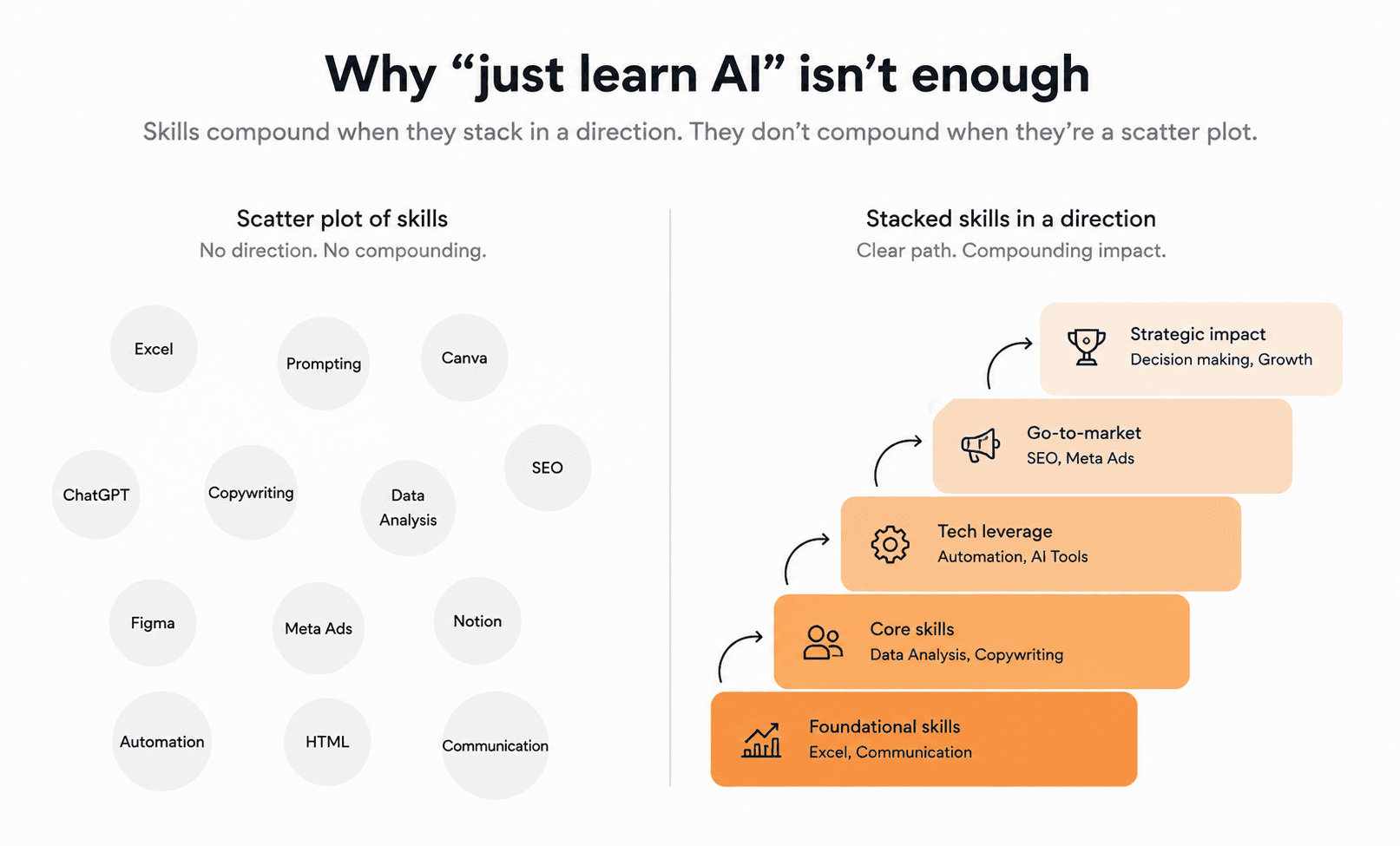
The people who get real returns tend to do something narrower: they identify the specific tasks in their own work that are most exposed, then deliberately build the adjacent capability that sits one level above those tasks. Not "learn AI." More like: the reporting is going to be automated, so become the person who decides what the reporting should measure.
Strategy beats information
A good plan answers four questions: where am I exposed, what's still safe, what should I learn first, and what does that unlock next. Content answers none of those, because content doesn't know anything about you. That gap — between abundant information and absent direction — is the actual problem worth solving.
Where Shiftlyn fits
Shiftlyn is a career evaluation tool built around that gap. It starts by looking at your actual work — your role, your task mix, your experience, how much AI you already use — and produces an assessment of where you're exposed and where you're not.
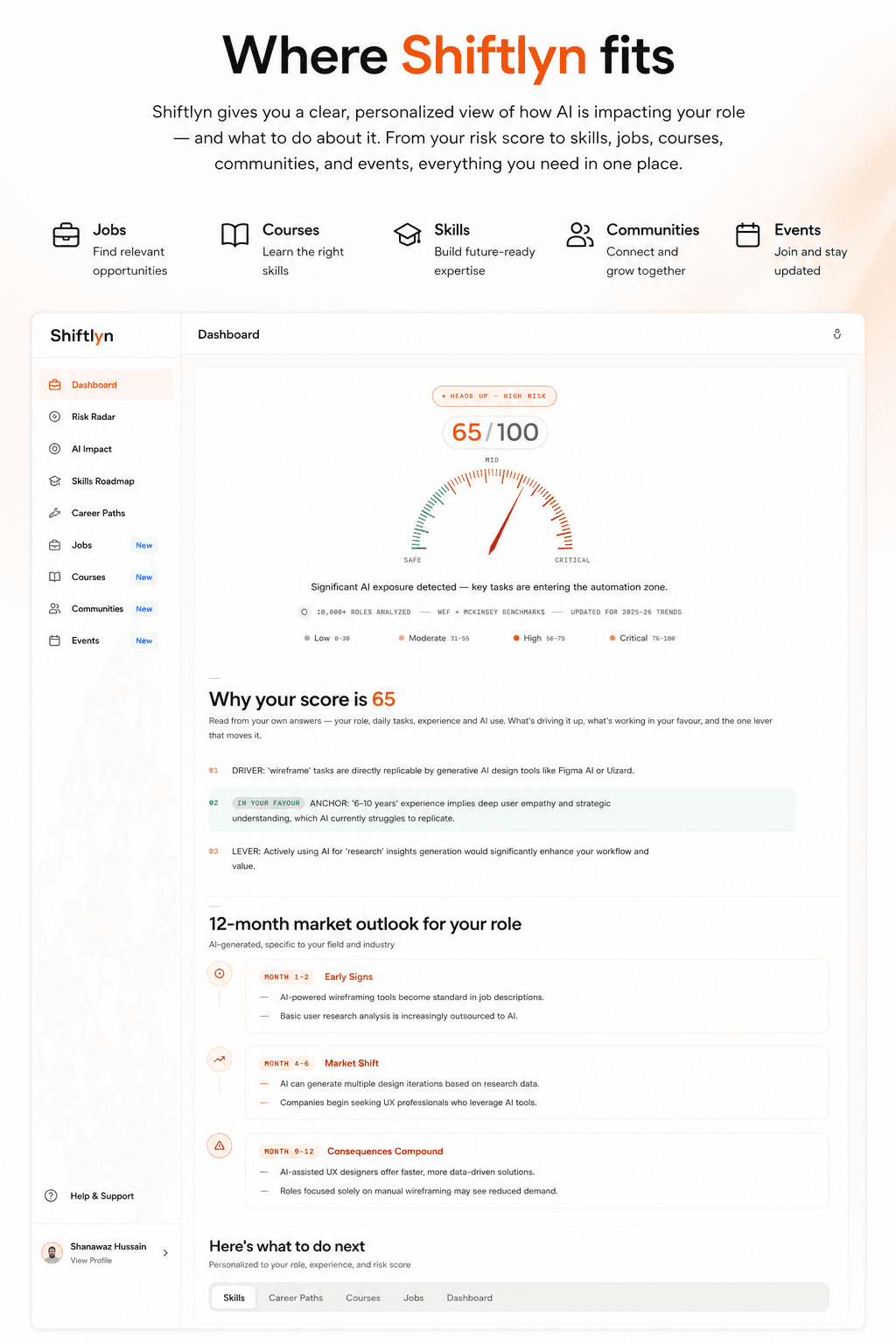
From there it turns the assessment into direction. Rather than handing you a score and wishing you luck, it maps out the skills worth building in your specific situation, layered so you know what comes first and what comes after. It surfaces career paths that your existing experience actually reaches, courses matched to the skills it recommends rather than to whatever is trending, and live job listings relevant to where you're heading. It points you toward communities and events where the people already doing that work spend their time — because a lot of career movement happens through people, not portals.
And it treats all of this as a roadmap rather than a verdict. Your work changes. You take on new responsibilities, pick up new tools, drop old ones. So you can re-run your assessment whenever that happens and see how your position has moved, instead of relying on a snapshot from eight months ago that no longer describes you.
None of this is a prediction about your employer. It's a structured read on your exposure, and a plan you can act on this quarter.
How Shiftlyn works
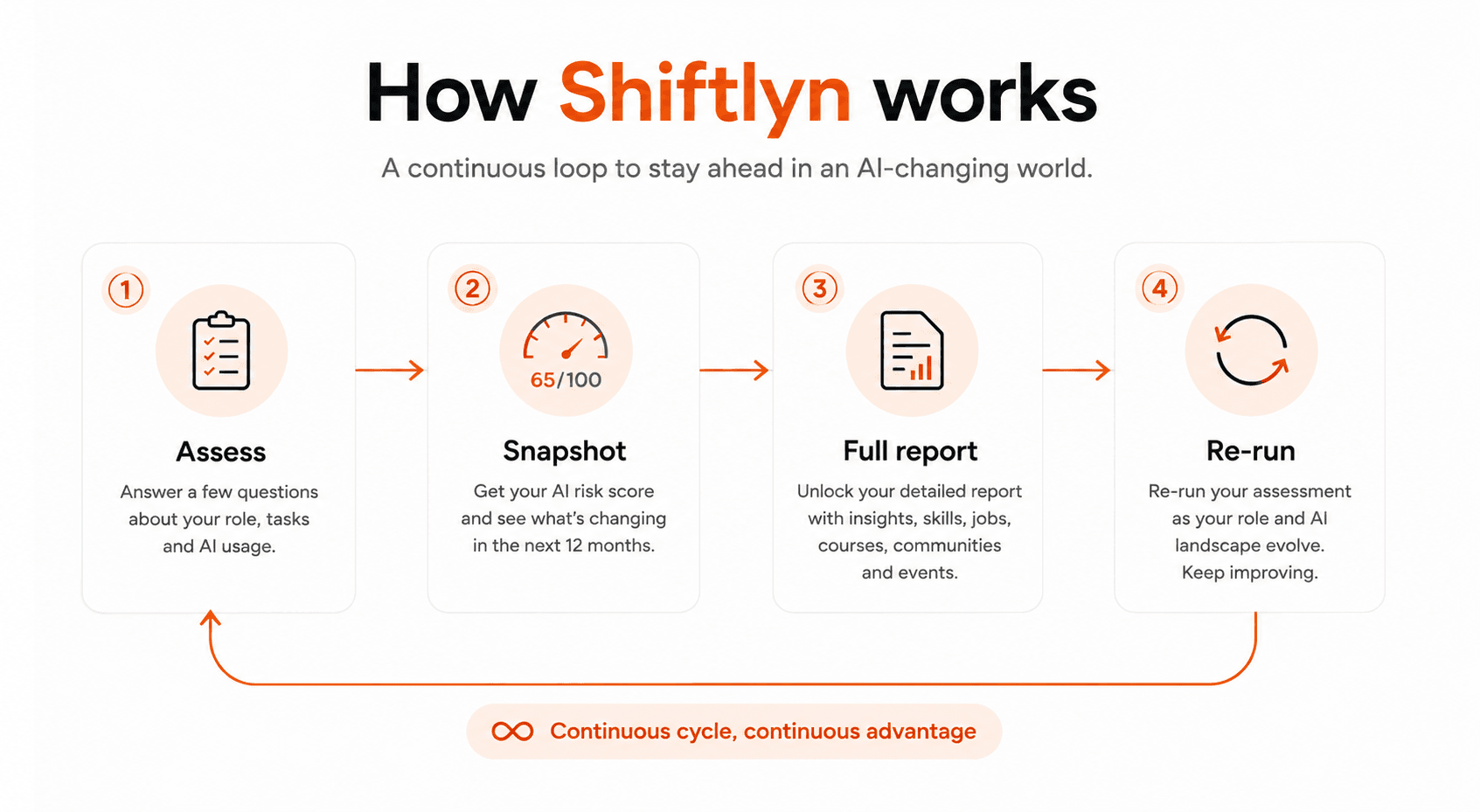
Step 1 — Take the assessment
Five questions about your role, industry, day-to-day tasks, experience level, and current AI usage. It takes about two minutes, and you don't need an account to start. The questions are deliberately about what you do, not what you're called, because that's where the signal is.
Step 2 — Get your free career snapshot
Immediately after, you get a free snapshot. It looks like this:
| What you get | Example | Why it’s there |
|---|---|---|
| AI Score | 62 / 100 | A single number for how exposed your current task mix is. |
| Risk Level | High | Banded so the number means something without a decoder ring. |
| Skill Exposure | Reporting, first-draft writing, data cleanup | The specific tasks driving the score — not the job title. |
| Reasoning | Routine, well-documented, text-and-numbers work | Why the score landed where it did, in plain language. |
| First Skill Recommendation | Analysis framing and decision support | One concrete place to start, chosen for your role. |
The reasoning matters as much as the score. A number without an explanation is just anxiety with a decimal point.
Step 3 — Unlock the full report
If the snapshot is useful and you want the plan behind it, the full report goes considerably deeper:
- A 30-60-90 day roadmap — sequenced actions, so you know what to do this month rather than someday.
- Level 1 skills — the foundations to build first, chosen for where you are now.
- Level 2 skills — what those foundations unlock once they're in place.
- Career paths — adjacent directions your current experience genuinely reaches.
- Courses — matched to the recommended skills, not to a sponsor list.
- Jobs — live listings relevant to the direction you're heading.
- The evidence behind each recommendation — the reasoning is shown, so you can disagree with it. A tool you can't argue with isn't giving you judgment, it's asking for faith.
Step 4 — Come back and re-run it
Careers move. Re-run your report whenever something meaningful changes — a new role, a shift in responsibilities, a skill you actually finished learning. Each run is saved, so over time you get a trend line instead of a single data point, and you can see whether the work you've been doing has moved your position or just filled your evenings.
Why continuous learning wins
The AI shift is not an event. There is no morning when the news announces that your field has changed and you should now respond. It's gradual, uneven, and mostly invisible day to day — which is exactly what makes it easy to miss.
Think about how a coastline erodes. Nothing dramatic happens in any given week. Then you look at a photograph from ten years ago and the shape is different. Careers erode the same way: a task gets automated here, a headcount doesn't get backfilled there, a job posting starts asking for something it didn't ask for two years ago.
Or think about fitness, which is the closer analogy. Nobody gets unfit on a specific Tuesday. It accumulates from a hundred unremarkable days. And critically, you can't undo it in a week either — recovery runs on the same slow clock as decline. This is the part people underestimate. Building a genuinely new capability takes months of consistent effort. A reorganisation takes weeks.
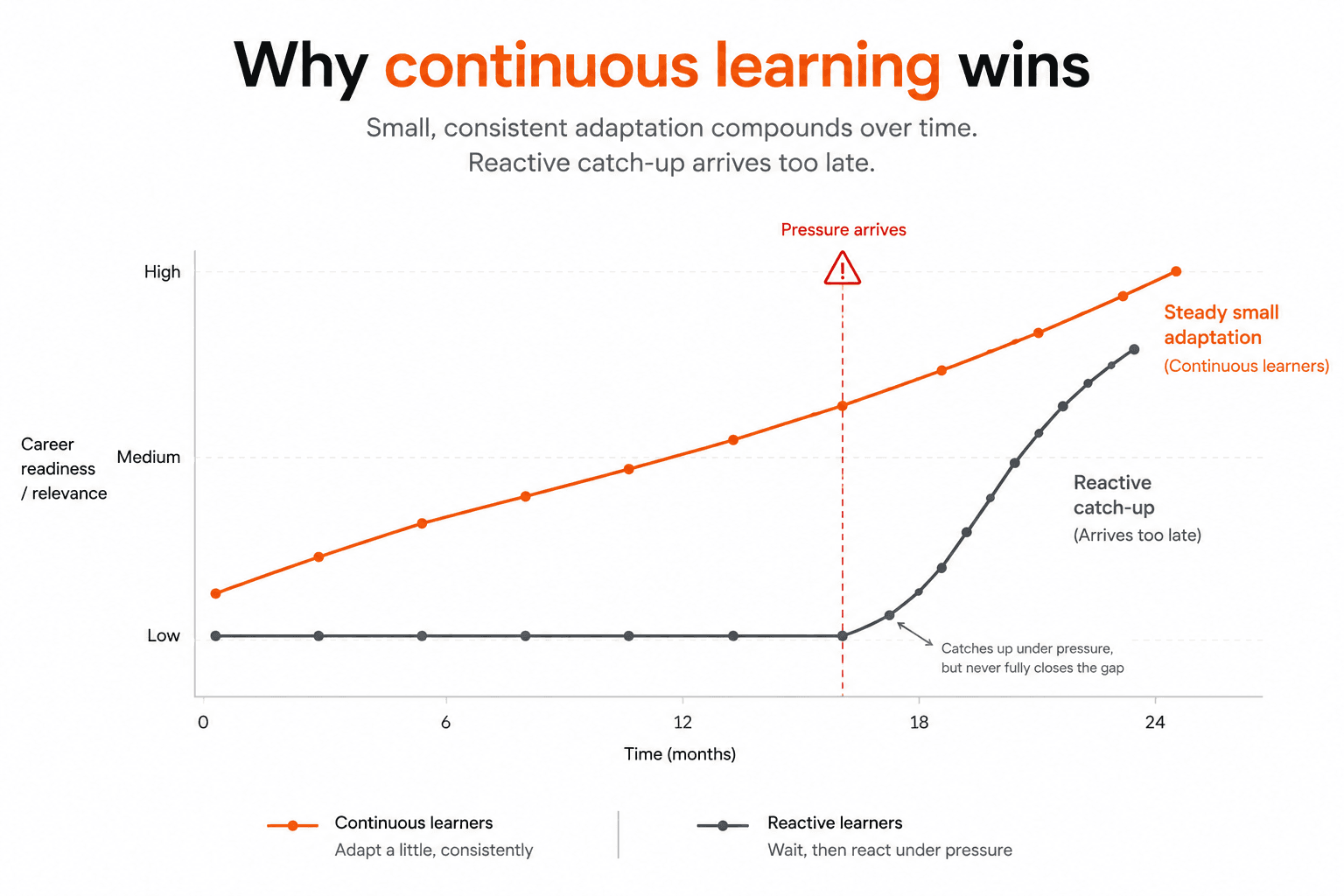
If you wait until your company demands AI skills, you are already behind — not because you're slow, but because the timelines don't line up.
The people who stay ahead are rarely the ones who made a single dramatic pivot. They're the ones who kept a small, steady habit of checking where things were moving and adjusting slightly. Small and continuous beats large and reactive, because small and continuous is the only version that's available before the pressure arrives.
Who Shiftlyn is for
- Professionals who suspect AI will affect their role and want a clearer read than a headline can give them.
- People deciding between adapting in place, deepening an existing strength, or moving toward adjacent work — and who want the tradeoffs laid out.
- Anyone who has started learning AI and stalled, because there was no way to tell whether they were learning the right things.
- Early-career professionals and students choosing a direction who would rather aim at where the work is going than where it was.
- People who want a plan they can start this month, not a five-year theory of the future of work.
Who it isn't for
Being clear about the limits is more useful than overselling, so:
- If you want to know whether you'll be laid off, this won't tell you. Shiftlyn does not predict layoffs. It has no visibility into your company's finances, your leadership's plans, or your industry's next quarter. Anything claiming otherwise is guessing with more confidence than it has earned.
- If you want certainty, no tool can offer it. What you get here is a structured, reasoned estimate of exposure — a well-informed second opinion, not a forecast.
- If you want someone else to do the work, this won't help either. The report tells you what to build. Building it is still months of your effort.
- If you're looking for reassurance, you may not get it. The assessment reports what it finds, including when that's uncomfortable.
What it does do is turn a vague, ambient worry into something specific enough to act on. That's a smaller claim than most tools in this space make, and it's the one we can actually stand behind.
Where to start
If you've read this far, you're already doing the useful thing: treating this as a question with an answer rather than a mood to manage. The next step is small. Spend two minutes on the free AI career assessment and find out which parts of your work are actually exposed and which are not.
You may find your risk is lower than you feared. You may find it's concentrated somewhere you weren't looking. Either result is more useful than the uncertainty you're carrying now — and both come with a first concrete step.
The window to act deliberately is always before you need to. That's now.